Research · Case study · Under revision

Liver tumors on multiphase CT: a high internal score, a dataset audit and an external test

A liver tumor classifier scored well on a public CT dataset. Part of that score came from how the scans were acquired, and the model transferred poorly to another hospital.

At a glance

Task
Tell apart three primary liver cancers on multiphase contrast-enhanced CT: hepatocellular carcinoma (HCC), intrahepatic cholangiocarcinoma (ICC) and combined hepatocellular-cholangiocarcinoma (cHCC-CCA).
Data
Public PLC-CECT dataset: 278 patients (94 HCC, 99 ICC, 85 cHCC-CCA), 56 of them held out. External MCT-LTDiag cohort: 203 patients from another hospital (103 HCC, 100 ICC).
Models
Multiphase 3D CNN (MONAI) trained with phase dropout; radiomics (PyRadiomics features, LightGBM); late fusion, with and without age and sex.
My role
Corresponding author. I led the methodology, software, analysis and writing, with Wen Xuezhi.
Status
Under revision, Journal of Intelligent Medicine and Healthcare (Tech Science Press).
Code
GitHub, release v2.4.2 (the version cited in the paper), MIT license.
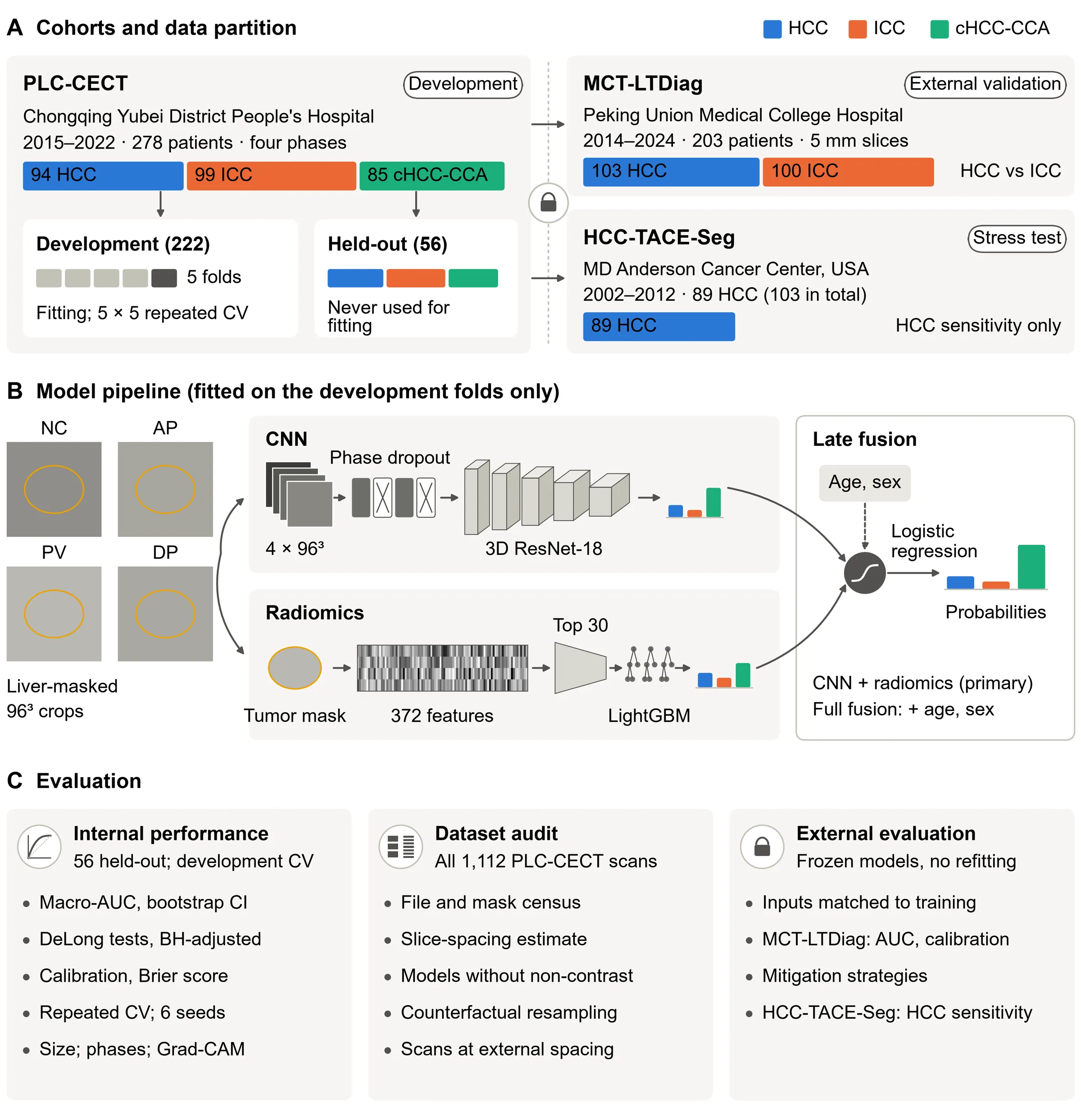
Diagram of the study: PLC-CECT split into 222 development and 56 held-out patients; MCT-LTDiag (203 patients) for external validation and HCC-TACE-Seg as an HCC stress test; the CNN, radiomics and late-fusion pipeline; and the evaluation plan.
Study design. Cohorts, the CNN, radiomics and late-fusion models, and the evaluation plan. Models were fitted on the development folds only; the 56 held-out patients were never used for fitting. Figure from the project repository (MIT license).

01

A strong internal score

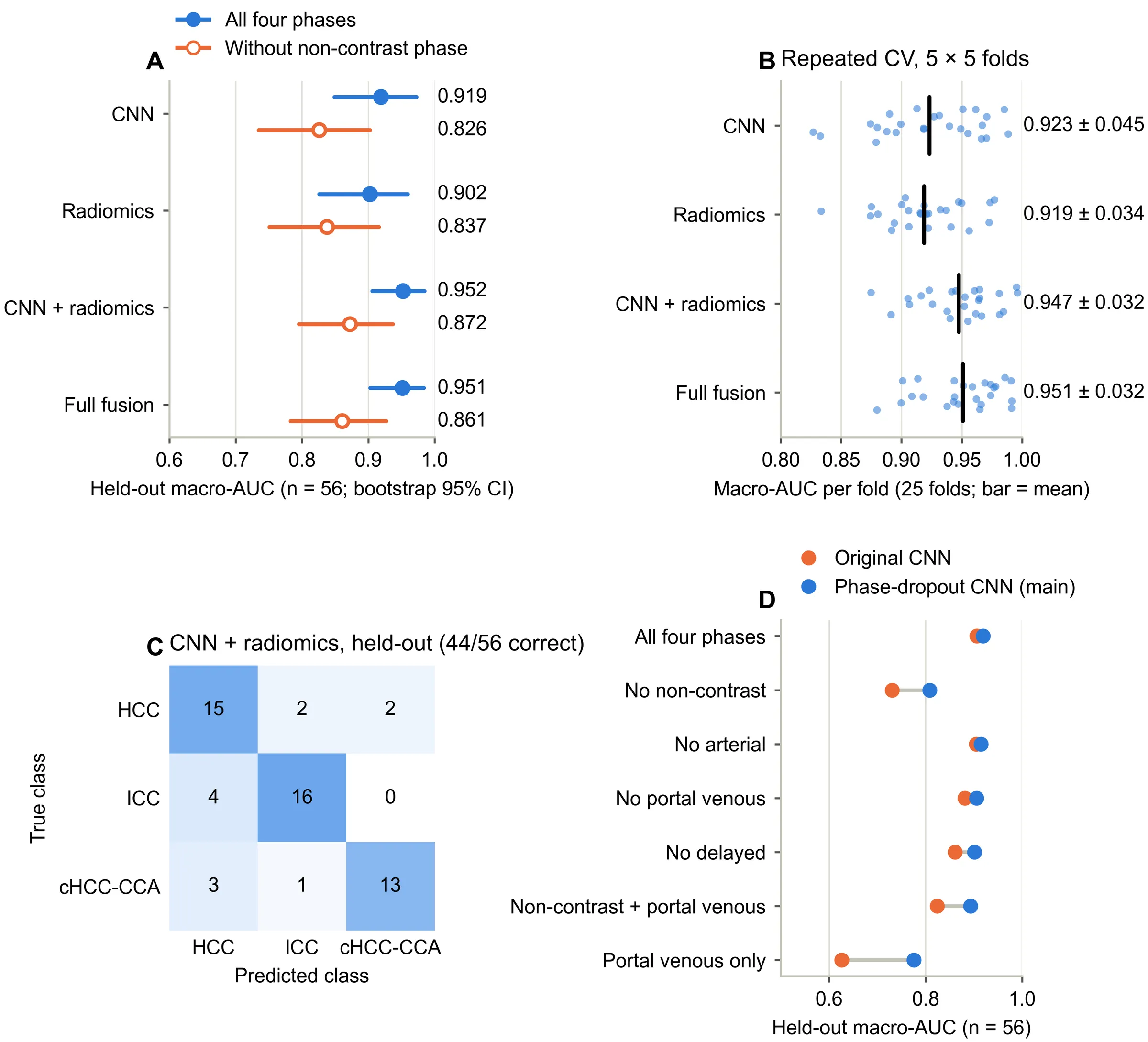
CNN plus radiomics reached a held-out macro-AUC of 0.952 (95% CI 0.906–0.985), or 0.947 ± 0.003 over six CNN training seeds. No fusion gain survived multiplicity adjustment, and age and sex added nothing.

Four panels: held-out macro-AUC per model with and without the non-contrast phase; per-fold results over 5 × 5 repeated cross-validation; the held-out confusion matrix for CNN plus radiomics; and the effect of removing single phases.
Internal performance. Held-out macro-AUC per model with and without the non-contrast phase, results over 5 × 5 repeated cross-validation, the held-out confusion matrix for CNN + radiomics, and the effect of removing single phases. Figure from the project repository (MIT license).

02

An audit of all 1,112 scans

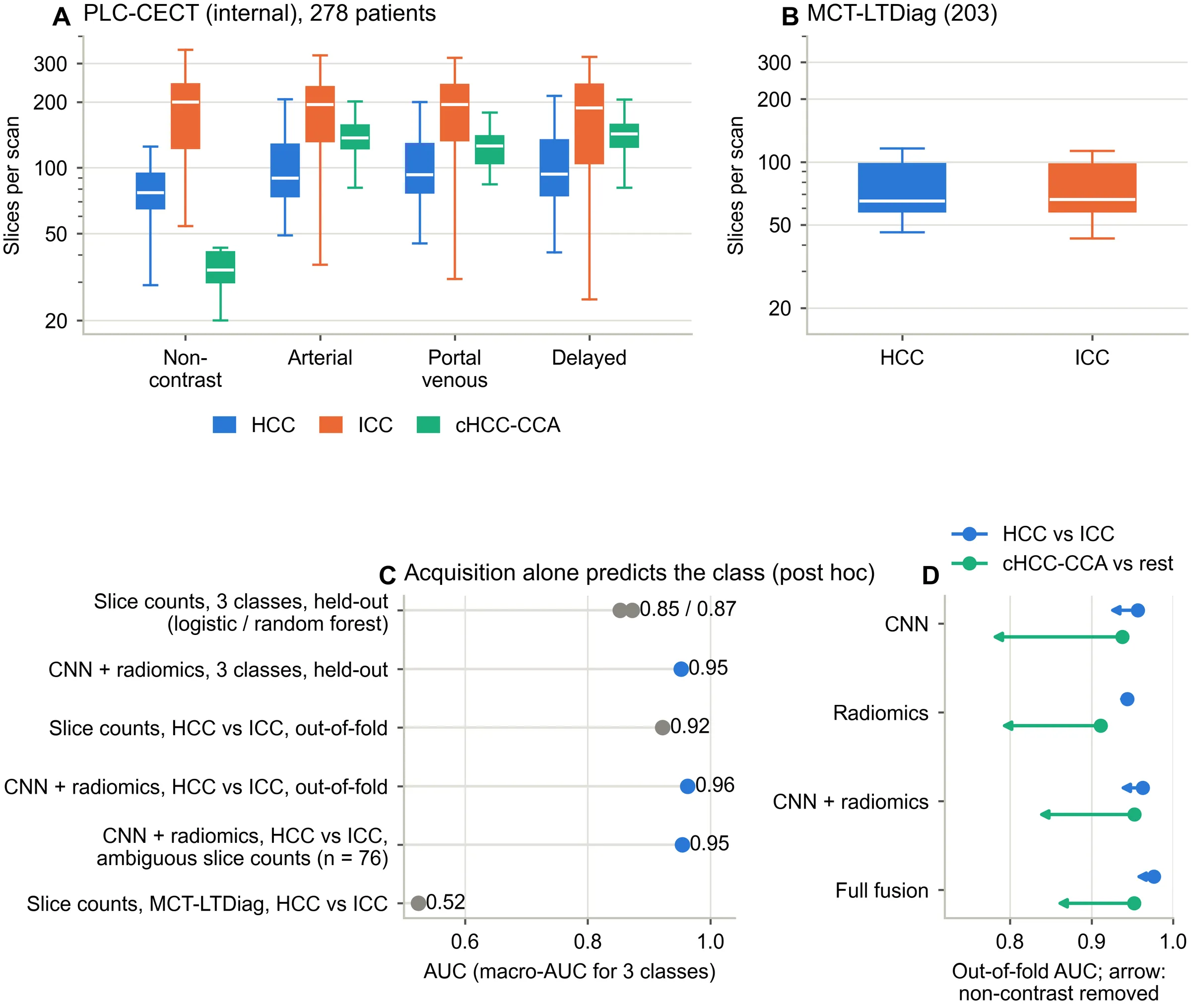
Before trusting that score, I checked how every scan in the dataset was acquired. In PLC-CECT, acquisition is confounded with class: slice counts alone predicted the class with a held-out macro-AUC of 0.85 (a post hoc analysis). The cHCC-CCA non-contrast scans had about 3.5 times fewer slices than the same patients' portal-venous scans.

Box plots of slices per scan by phase and class: in PLC-CECT the cHCC-CCA non-contrast scans have far fewer slices, while the external cohort's two classes look alike; plus a chart of how well slice counts alone predict the class.
Acquisition differs by class. Slices per scan by phase and class in PLC-CECT (A) and in the external cohort (B); how well slice counts alone predict the class, post hoc (C); and the change in out-of-fold AUC when the non-contrast phase is removed (D). Figure from the project repository (MIT license).

03

Proof that the CNN uses the artifact

I edited scans to add or remove the artifact and measured the change in the CNN's output.

  • Injecting the cHCC-CCA non-contrast artifact into HCC and ICC scans raised the CNN's cHCC-CCA probability by 0.25 (0.21–0.30).
  • Repairing it in cHCC-CCA scans lowered that probability by 0.50 (0.42–0.58).
  • In a separate test, simulating a thick non-contrast reconstruction raised it by 0.28 (0.24–0.33).
Illustration: the same patients' portal-venous scans have about 3.5 times more slices than their non-contrast scans PORTAL VENOUS NON-CONTRAST
In the public dataset, cHCC-CCA non-contrast scans have about 3.5 times fewer slices than the same patients' portal-venous scans. Illustration, not to scale.

04

The external test

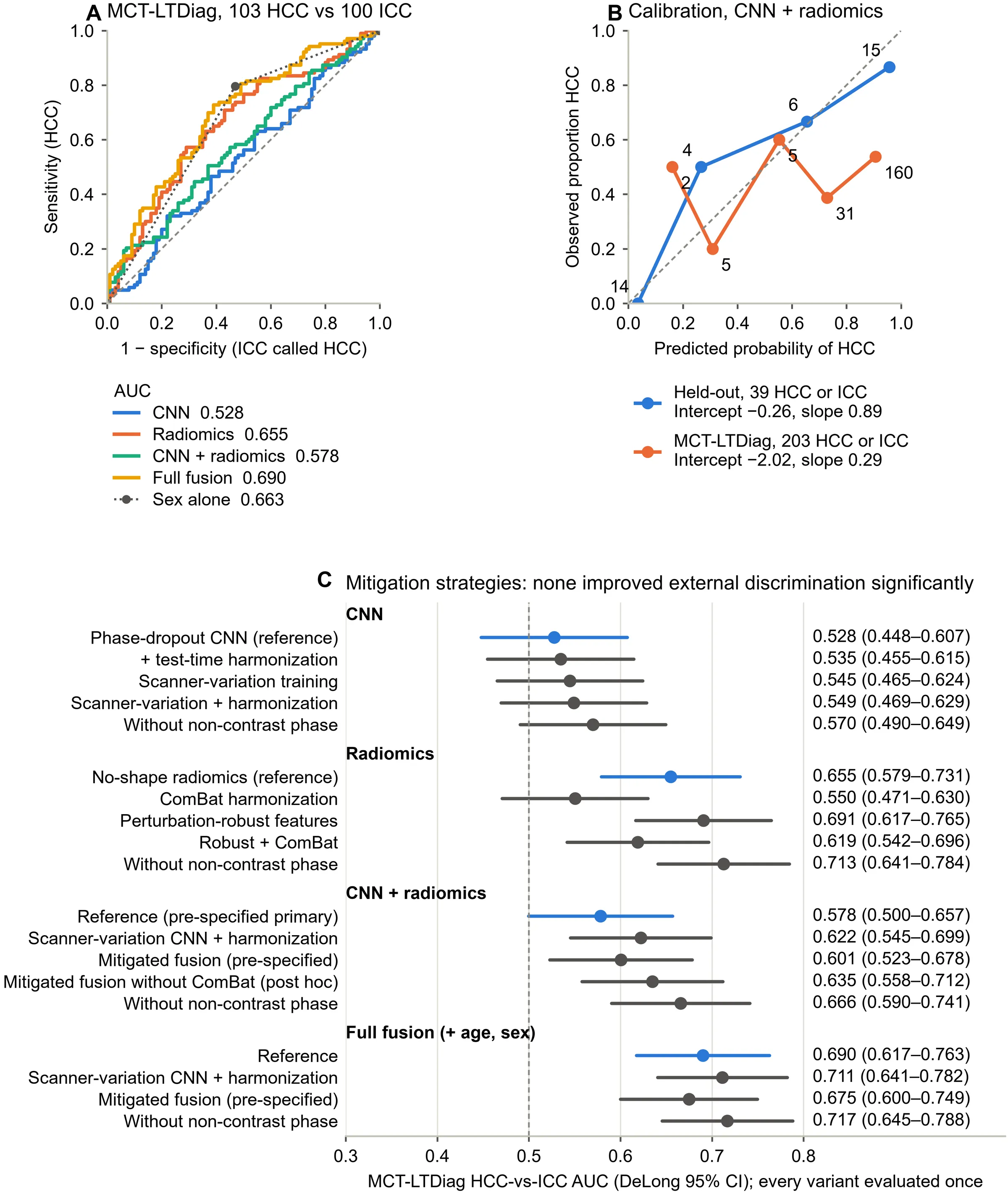
On 203 patients from another hospital, the HCC-versus-ICC AUC was 0.578 (0.500–0.657), at most marginally better than chance. The model recognized 2 of 100 ICC patients. cHCC-CCA could not be validated externally, because the external cohort has only HCC and ICC. No mitigation strategy helped significantly.

ROC curves for each model on the external cohort, a calibration plot for CNN plus radiomics, and a forest plot of mitigation strategies whose confidence intervals overlap the reference models.
External validation on MCT-LTDiag (103 HCC, 100 ICC). ROC curves, calibration of CNN + radiomics, and mitigation strategies; none improved external discrimination significantly. Figure from the project repository (MIT license).

05

How much of the drop acquisition explains

Giving the internal scans the external cohort's slice spacing lowered the internal HCC-versus-ICC AUC from 0.947 to 0.795. That drop equals 41% of the external loss (post hoc 95% CI 12–88%), so the tests cannot pin down the exact share. Models retrained at that spacing were not better externally.

06

What I take from it

  • Audit the acquisition before modelling. Slice count and spacing can carry the label.
  • Test what a model uses, not only how well it scores. A counterfactual edit shows whether a shortcut drives the predictions.
  • Report external results even when they are poor. Internal performance on this public dataset partly reflects how the scans were acquired.
  • Release the code and aggregate results. Others can then check the work.

07

Built to be checked

I organized the study into research notebooks and a reusable Python package with pytest, continuous integration, smoke tests and release validation. Release v2.4.2 includes a manifest and aggregate cohort results; the public clone runs without patient-level data.

Not for clinical use. These models are research software and are not suitable for clinical use.

08

Cite

Wen X., El Massaoudy H.*

Multimodal Classification of Primary Liver Tumors on Multiphase CT: Internal Performance, Acquisition Artifacts, and Limited External Transportability

Journal of Intelligent Medicine and Healthcare (Tech Science Press).

Under revision

BibTeX
@unpublished{wen2026liver,
  author = {Wen, Xuezhi and El Massaoudy, Hamza},
  title  = {Multimodal Classification of Primary Liver Tumors on
            Multiphase {CT}: Internal Performance, Acquisition
            Artifacts, and Limited External Transportability},
  note   = {Manuscript under revision at the Journal of Intelligent
            Medicine and Healthcare (Tech Science Press)},
  year   = {2026}
}